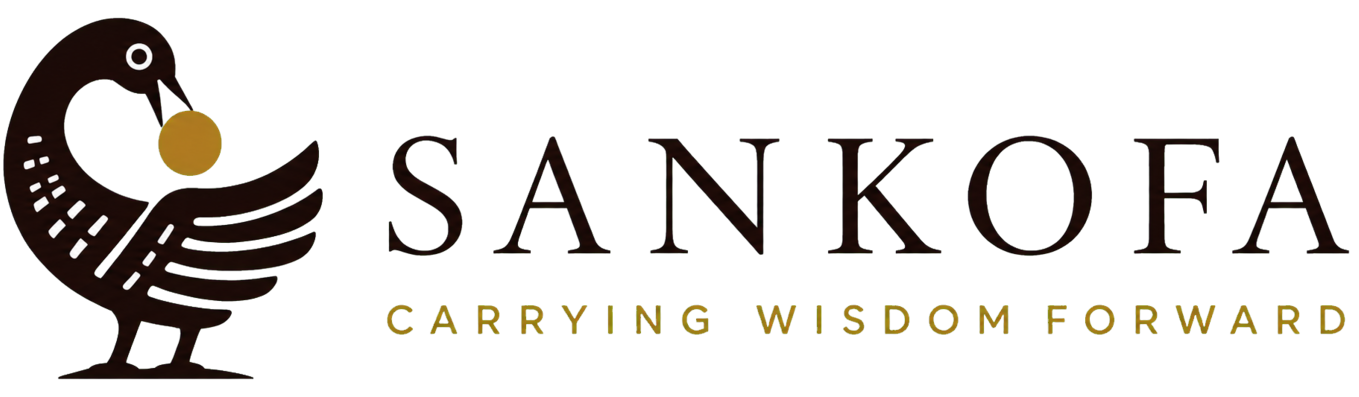

The Sankofa bird is moving forward, but its head is turned towards what lies behind it. In its beak, it carries an egg.
The first time you encounter the image, you may simply see a beautiful bird. But once you understand what it is doing, the symbol becomes difficult to forget. The bird is not retreating. Its feet remain pointed towards the future. It looks back because there is something behind it worth retrieving.
That something is represented by the egg.
Go Back and Fetch It
Sankofa comes from the Akan people of Ghana. The word is commonly translated as “go back and fetch it” or “go back and get it.”
It is associated with the Akan proverb:
Se wo were fi na wosan kofa a yenkyiri.
The proverb is commonly understood to mean:
It is not wrong, or forbidden, to return for what you have forgotten or left behind.
Stockton University’s explanation of Sankofa describes it as a Twi word that comes from this proverb and conveys the importance of returning to retrieve something valuable from the past.
The idea is represented through two well-known Adinkra symbols. One resembles a stylised heart. The other is the mythical bird we have chosen for this platform, facing forward while turning its head back.
Adinkra symbols communicate philosophical ideas through images. They allow values, proverbs and inherited wisdom to be carried visually as well as through language.
The Smithsonian’s National Museum of African Art describes the backward-looking bird as one of the more widely recognised symbols among the Akan peoples. It explains Sankofa as learning from the past as a way of moving forward into the future.
The Meaning of the Egg
In the version of the symbol used for this platform, the bird carries an egg. The egg is not incidental. It is the reason the bird looks back.
It represents something valuable, something fragile and something capable of giving life to what comes next. It may represent knowledge, memory, identity, cultural inheritance or wisdom passed between generations. It may also represent possibility.
An egg contains something that has not yet fully emerged. It belongs partly to what already exists and partly to what is still becoming. The bird therefore does not return simply to recover an object from the past. It retrieves something that may help give life to the future.
Why the Bird Resonates With Me
I am drawn to the Sankofa bird because it holds tension without trying to eliminate it. It remembers while moving. It honours the past without becoming trapped inside it.
The bird suggests that progress and memory are not enemies. We do not have to choose between looking back and moving forward. Sometimes the only way to move forward with clarity is to understand what has brought us here.
That principle resonates with me personally, but it also connects deeply with my work. Through Paperclip Limited, I spend a great deal of time helping organisations examine their systems, structures and ways of working.
Organisations often want to move quickly towards a new strategy, policy or operating model. They are eager to discuss what comes next. But the present rarely makes sense without the past.
Why do employees distrust a new initiative? What happened the last time change was introduced? Why does knowledge disappear when one person leaves? What was never documented, transferred or shared? Why does an institution keep repeating the same mistake under different leadership? What part of its history has it refused to examine?
What looks like resistance may be memory. What appears to be inefficiency may be the result of a system built for conditions that no longer exist. What seems like a new problem may be an old one that was never properly understood.
The Sankofa bird reminds me that looking back is not a distraction from building the future. It is part of the work.
When the Answers Are Always Somewhere Else
The symbol holds an even deeper meaning for me as a person from the Global South.
Many of us have been educated within systems that taught us, directly and indirectly, that the most credible knowledge comes from somewhere else. The theory, the model, the expert and even the standard against which we measure ourselves were often created somewhere else.
We learn to look outward for answers before examining what our own people, histories and experiences might already have taught us. This is not because the Global South lacks knowledge. It is because much of our knowledge has not been given the same recognition, amplification or institutional authority.
Some of it was deliberately displaced through colonisation. Languages, systems of knowledge, spiritual practices and community structures were dismissed as primitive, backward or informal. External systems were installed and presented as more advanced, rational or legitimate.
Other knowledge remains overlooked because it is not recorded in the formats institutions recognise. It may be held in memory, practice, oral history, craft, relationships or ways of responding to difficulty that communities have developed over generations.
A farmer may understand changes in weather long before those observations become part of a formal report. A market vendor may understand enterprise, negotiation and human behaviour without ever being invited to speak at a business conference.
An elder may carry the history of a community that cannot be found in an archive. A public officer who has served through several administrations may understand why a policy repeatedly fails, even if no one has asked. A small island may know something about adaptation, interdependence and living with vulnerability that a larger country has never had to learn.
What would change if we treated these people and experiences as sources of knowledge?
Not Everything Behind Us Should Be Carried Forward
Sankofa does not ask us to romanticise the past. This distinction matters.
Not every tradition is wise. Not every inherited practice should be preserved. History contains injustice, exclusion and harm as well as resilience, creativity and knowledge.
The bird does not carry everything it finds. It retrieves the egg. That suggests discernment.
We must look back carefully enough to decide what remains valuable, what needs to be repaired and what should be left behind.
For countries in the Global South, reclaiming our own knowledge should not mean closing ourselves off from the rest of the world. We need exchange, research, new ideas and perspectives that challenge us. No country or region possesses all the answers it needs.
The problem is not that knowledge comes from outside us. The problem is the assumption that valuable knowledge can only come from outside us.
There is a difference between learning from the world and believing that the world has nothing to learn from us. Sankofa lives inside that difference.
What Are We Being Asked to Retrieve?
The bird invites us to ask better questions.
What have we forgotten because someone taught us it had no value? What knowledge disappeared when a language, craft or way of life began to fade? What did previous generations understand about community, care, land, work and survival?
What have our countries learned from crises that others may one day face? Whose experience has been excluded from the official record? What has never been documented because the person carrying the knowledge was not regarded as an expert?
We must also ask what we are carrying simply because it is old, even though it no longer serves us.
These are not questions only for historians. They belong in boardrooms, schools, governments, homes and communities. They belong wherever people are trying to build something that must survive beyond the present moment.
Why the Bird Belongs to Sankofa
This platform is built around conversations connecting Africa, the Caribbean, Asia and the wider Global South. It begins with the belief that wisdom should not travel in only one direction.
We can learn from one another without pretending that our countries are the same. We can recognise our differences without allowing them to prevent exchange. We can receive knowledge from elsewhere while becoming more attentive to what is already alive within our own societies.
The Sankofa bird represents how I want to approach that journey: with curiosity, but not emptiness; with openness, but not the belief that the answers must always come from somewhere else; and with respect for history, but without surrendering the future to it.
The bird looks back because something valuable is there. The egg reminds us to retrieve it carefully, while its feet remind us that the journey must still continue.
Perhaps that is what Sankofa asks of us in the Global South: to stop approaching the future as though we have nothing in our hands.
We are already carrying knowledge. The work is to recognise it, examine it and decide what is worthy of being carried forward.