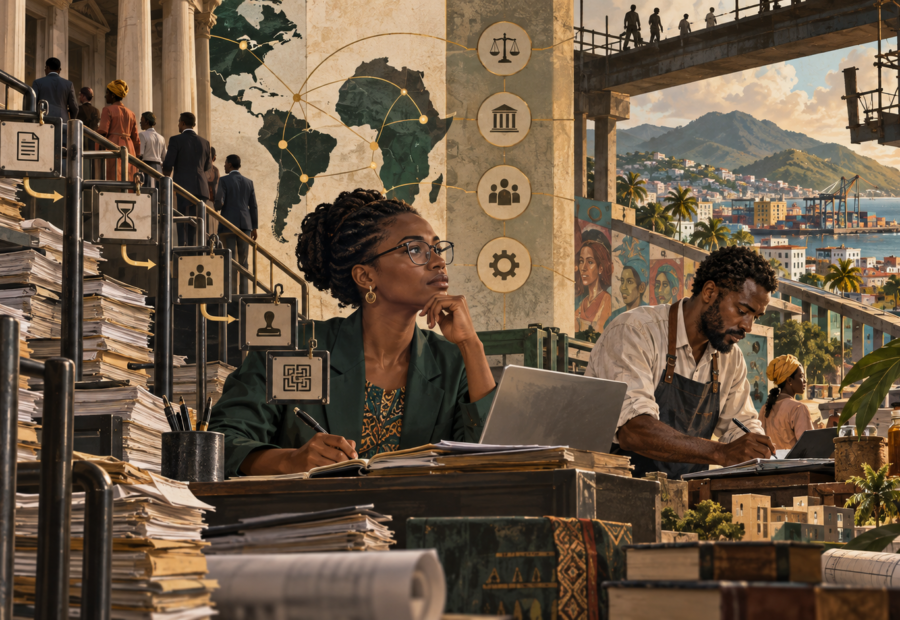

The Global South is often studied, advised, measured and compared. Its countries are frequently discussed in reports, development programmes and international conferences. Experts arrive to assess problems, recommend solutions and introduce models developed elsewhere.
Some of this work is valuable. Countries benefit from research, international cooperation and ideas that challenge familiar ways of thinking. But what happens when we turn the question inward? What might we learn if we took our own countries, institutions, communities and experiences seriously as sources of knowledge?
What might change if we became as curious about what is working in Ghana, Grenada, Kenya, India, Brazil or Indonesia as we are about models developed in Europe and North America?
The question is not whether the Global South should stop learning from the rest of the world. It is whether we have paid enough attention to what the Global South might learn from itself.
Knowledge Lives Here Too
Knowledge does not exist only in universities, policy papers, consulting firms or international institutions. It also lives within communities and is carried by people whose expertise may never be formally recognised.
It is carried by farmers who understand changing weather patterns and the behaviour of the land, and by fishers who can read the sea. It is practised by families that have created systems of care where formal services are limited. It is developed by entrepreneurs who build businesses despite small markets, unreliable infrastructure and restricted access to finance.
It can also be found in public officers who understand why certain policies repeatedly fail, even when the official reports do not explain it. It is preserved by elders, artisans, community leaders, workers and people whose knowledge has been developed through years of experience.
This knowledge may not always be written down or expressed in the language institutions use. It may be carried through stories, routines, relationships, craft, memory and ways of responding to difficulty that have been tested over generations.
The fact that knowledge is informal does not make it insignificant. The fact that it is local does not mean it has nothing to offer the wider world.
When Expertise Travels in One Direction
Countries in the Global South have often been positioned as places where problems exist and expertise must be delivered. The theory comes from elsewhere. The consultant comes from elsewhere. The model, funding conditions and standards used to measure success may also have been created somewhere else.
This can encourage the belief that progress begins when a country adopts an external model. Sometimes an external model is exactly what is needed. But importing an idea without understanding the place in which it must work can create another set of problems.
A policy developed for a large, wealthy country may not suit a small island state. A management model built for a highly formal economy may not reflect a society where informal work supports thousands of families. A system that assumes strong public infrastructure may fail where institutions are under-resourced.
A programme may look successful on paper while ignoring the relationships, histories and cultural expectations that shape how people actually behave.
The problem is not that the idea came from outside. The problem arises when outside knowledge is automatically treated as superior while local experience is overlooked.
Learning From Comparable Realities
Countries may find some of their most useful lessons in places that reflect aspects of their own reality.
A small Caribbean state may learn from another island country facing similar pressures from climate change, migration, limited markets and high import costs. A city in Africa experiencing rapid urban growth may have more to exchange with a city in South Asia than with a European capital built under very different conditions.
Countries with large informal economies can learn from one another about taxation, social protection, entrepreneurship and access to finance. Communities affected by hurricanes, droughts, flooding or coastal erosion can exchange practical knowledge about preparedness, recovery and adaptation.
The similarities do not need to be exact. No two countries have the same history, culture or institutions. The value lies in recognising comparable challenges and becoming curious about how others have responded.
What worked, and what failed? What had to be adapted? What was overlooked? What would the people involved do differently now?
These questions can shorten the distance between a problem and a workable response.
We Have Already Created Solutions
The Global South is not waiting to begin innovating. It has already produced ideas, practices and systems that have influenced the wider world.
Countries across Africa have helped expand the possibilities of mobile money and digital financial services. Community health worker models across parts of Africa, Asia and Latin America have shown how care can reach people beyond hospitals and major urban centres.
Caribbean countries have developed extensive experience in disaster preparedness, hurricane recovery and regional coordination. Cooperatives across Africa, Asia, Latin America and the Caribbean have enabled people to pool resources, strengthen their bargaining power and build enterprises collectively.
Brazil has contributed influential approaches to participatory governance and social policy. India has developed large-scale systems in digital identity, affordable healthcare, technology and community enterprise.
Small island states have also become some of the strongest voices in international climate discussions because they understand that environmental vulnerability is not an abstract future concern. It is a present reality.
None of these examples is perfect. Every model has limitations, and every success must be understood within its context. But together they demonstrate an important truth: the Global South is not only a place where solutions are needed. It is also a place where solutions are being created.
South-South Learning Is More Than Government Cooperation
The term South-South cooperation is often used to describe collaboration among countries of the Global South. This may include governments sharing technical knowledge, universities conducting joint research, businesses entering new markets or countries cooperating through regional and international organisations.
But learning across the Global South does not need to belong only to governments or large institutions. It can also happen directly between people.
A Grenadian farmer and a Ghanaian farmer may discover common questions about climate, soil, markets and the survival of small-scale agriculture. A Caribbean hotel manager may learn from an African tourism professional navigating similar questions about culture, service and local ownership.
A craft producer in Indonesia may have useful experience to share with an artisan in the Caribbean. A public officer in Rwanda may understand something about institutional reform that is relevant to a colleague in Jamaica. A researcher in India may encounter ideas in Brazil that change the way a problem is understood, while a young entrepreneur in Kenya may develop a model that could be adapted in Trinidad and Tobago.
These exchanges do not require people to pretend that their countries are the same. They require curiosity, respect and a belief that knowledge can travel in more than one direction.
Learning With, Not Simply Learning From
There is an important difference between learning from someone and learning with them.
Learning from can sometimes create a hierarchy in which one person becomes the expert and the other becomes the recipient. Learning with suggests a more equal relationship. Both sides bring experience, ask questions and remain capable of teaching and being taught.
This does not mean ignoring differences in expertise, resources or experience. It means refusing to assume that one side arrives full of knowledge while the other arrives empty.
The best exchanges are not acts of charity. They are relationships in which people recognise that each person has something of value to contribute.
For the Global South, this shift matters. Our countries have often met one another through institutions created elsewhere. We may know one another through development programmes, diplomatic meetings, trade agreements or international conferences.
There is room for more direct conversation, more practitioner-to-practitioner exchange and more collaboration between researchers. There is room for stronger relationships among artists, entrepreneurs, communities and institutions, as well as more opportunities to understand how other societies are responding to problems we also face.
We Must Still Ask Difficult Questions
Learning from the Global South should not become another form of romanticism. Not every local practice is wise, every government programme deserves to be copied or every tradition should be protected from criticism.
Countries across the Global South also experience corruption, inequality, exclusion, weak institutions, political repression and harmful social practices. A solution developed in one Southern country can still fail in another.
Power does not disappear simply because people share the label Global South. Larger and wealthier Southern countries can dominate smaller ones. Governments can silence communities. Institutions can ignore the knowledge of their own people while celebrating South-South cooperation internationally.
We must therefore examine our own models with the same seriousness we apply to those imported from elsewhere. What evidence supports them? Who benefits, and who is excluded? Can the idea be adapted? Does it depend on conditions that do not exist elsewhere? What harm might it cause?
Respecting our knowledge does not mean protecting it from scrutiny. It means believing that it is worthy of being examined, tested and developed.
Why This Matters to Sankofa
Sankofa begins with the belief that wisdom should not travel in only one direction. This platform is interested in what people across Africa, the Caribbean, Asia, Latin America and the wider Global South already know.
That includes more than what governments say in official speeches, what appears in development reports or what recognised experts publish. Sankofa is also interested in the knowledge carried through work, memory, community, culture and lived experience.
What has a small country learned from surviving repeated disruption? What does an organisation understand after decades of adapting to limited resources? What has a community discovered about care when formal systems are absent?
What does an artisan know about preserving identity while responding to changing markets? What has a public institution learned from reforms that did not work? What ideas are emerging among young people trying to build a future under conditions very different from those experienced by earlier generations?
Sankofa creates space for these questions and the conversations that may follow.
It does not begin with the assumption that every answer already exists within the Global South. It begins with the belief that we have not listened carefully enough to discover what does.